Friday, November 11, 2011

GEF Council Approves “Blue Forests” Project

Blue Carbon included in "Blue Forests" project, Project Preparation Grant (PPG) next...
_________________________________________________

GEF council members approve more than half a billion dollars worth of projects – the second largest GEF work program in its history


Washington DC, November 9, 2011

Today the GEF Council, the governing body of the Global Environment Facility, approved an unprecedented large work program within the fifth replenishment cycle of the GEF. With 40 stand alone projects and 9 programmatic approaches amounting to $516.40 million, this work program represents double the average submissions made since its creation 20 years ago.

In addition, an impressive amount of $4.1 billion has been leveraged from GEF partners to further expand the reach of the program. As a result, 99 recipient countries will benefit from this work program alone, the largest number ever included in a single submission by the GEF.

This work program is however, not only remarkable because of its size, but also due to the key innovations around which it has been designed.

In terms of programmatic strategy, this work program addresses environment issues in the most holistic, comprehensive manner achieved so far, as evidenced by twenty one multi-focal area projects, joint GEF Agency (UNDP, UNEP, World Bank) partnerships in four projects/programs submitted and four initiatives combining the GEF resources with those of other environment related trust funds. Comparative advantages of each partner, are assembled in this most effective program implementation arrangement ever put together by the GEF.

For example, with the Marine and Coastal Protected Areas project, Brazil will significantly increase protection of its marine area by addressing unsustainable fishing practices, discharge of pollutants and industrial impact in an integrated manner. In addition, this project includes financing mechanisms to generate revenues for the sustainable management of these protected areas through climate change related mechanisms (Blue Carbon) and payment for ecosystem services.

This work program includes many other large-impact projects around the world. For example in China, the Main Streams of Life-Wetland Protected Area System Strengthening for Biodiversity Conservation will create a strong national system for managing 48,962,400 hectares of wetlands, and protect an additional 1.7 million hectares containing 50 unprotected threatened species.

Similarly, the impact of Sustainable Forest Management (SFM/REDD+) projects will in this work program reach proportions never achieved before. Through the involvement of indigenous peoples and local communities these projects alone will save over 3 million tons of CO2 emissions in combating deforestation and forest degradation, while creating 2.5 million hectares of new protected areas, and implement sustainable management regimes across1.3 million hectares more.

One of the most innovative International Waters initiatives in this work program is the “Blue Forests” project. Research has recently found coastal habitats like mangroves, sea grass beds, coral reefs, and salt marshes (referred to as Blue Forests) to trap more carbon per unit area than terrestrial habitats. For the first time their true worth as key assets in environmental management has been recognized. The objective of this project is to develop methodologies to estimate carbon trapped by coastal and marine systems as well as to demonstrate their economic value.

This most ambitious work program reflects a holistic approach to environmental challenges, is based on community and indigenous people participation, maximization of impact through strong partnerships and financial leverage, all of which are a direct result from the string of key reforms that the GEF has carried out during the last few years.

Thursday, November 10, 2011

Coastal Blue Carbon & NOAA

The US National Oceanic and Atmospheric Administration (NOAA) is setting the standard high for Blue Carbon sites with their Coastal Blue Carbon web page. This may be the first “government” site on Blue Cabron. Please see the links, the site speaks for itself.


Congratulations to NOAA and the Habitat Conservation Office!

-Steven

Monday, November 7, 2011

Ecosystem Services Toolkit

Carbon services included...
___________________________

A ‘toolkit’ for measuring ecosystem services at the site scale is released

http://www.unep-wcmc.org/a-toolkit-for-measuring-ecosystem-services-at-the-site-scale-is-released_751.html

'Measuring and Monitoring Ecosystem Services at the Site Scale' introduces a new ‘toolkit’ for measuring ecosystem services at the site scale which is accessible to non-experts and delivers scientifically robust results. This booklet explains some key concepts including the need to consider a ‘plausible alternative state’ to measure differences resulting from changes in land management and use, and the importance of identifying beneficiaries.

The work has been coordinated by researchers and conservation biologists from Anglia Ruskin University, BirdLife International, Cambridge University, Royal Society for the Protection of Birds and UNEP World Conservation Monitoring Centre, with input and guidance provided by over 50 other scientists.

What can the toolkit do?
  • Help users with limited capacity (technical knowledge, time) and resources (money, ‘man’ power) to measure ecosystem services.
  • Provide simple gross assessments of ecosystem services at sites, and a way of assessing how these would change if the sites were altered.
  • Provide scientifically robust information on ecosystem services—a first step which can guide practitioners on whether more detailed studies would be useful.
  • Indicate who will be the ‘winners’ and who will be the ‘losers’ as a result of any change in land use and ecosystem service delivery.
  • Help decision-makers appreciate the true value of nature, and the consequences of destruction and degradation of natural habitats.
The methods and approaches presented in the toolkit have been tested at four sites to-date (2011), including Shivapuri–Nagarjun National Park (Nepal), Phulchoki Mountain Forest (Nepal), Montserrat Centre Hills (Montserrat) and Wicken Fen (UK), with implementation and support from Bird Conservation Nepal, the Department of Environment in Montserrat and the National Trust in the UK. In 2012, there are plans for further testing at a number of additional sites and publication of the methods and results through the peer-reviewed scientific literature, as well as the development of a ‘toolkit’ user-manual.

The toolkit has been developed, thus far, through two projects: A Cambridge Conservation Initiative (CCI) project entitled ‘Measuring and monitoring ecosystem services at the site scale: building practical tools for real-world conservation’ and a BirdLife International / Darwin Initiative project entitled ‘Understanding, assessing and monitoring ecosystem services for better biodiversity conservation’.

The booklet is available to download below:


Saturday, November 5, 2011

Global Blue Carbon Market Proposed by Five UN Agencies

Global Blue Carbon Market Proposed by Five UN Agencies


PARIS, France, November 1, 2011 (ENS) - A global blue carbon market that would create direct economic gain for those who protect ocean habitats is the main feature of a plan issued today by five United Nations agencies to improve the management of the world's ocean and coastal areas.

The "Blueprint for Ocean and Coastal Sustainability" says that the agencies intend to work with existing international carbon markets to define and implement a blue carbon market for protecting marine and coastal carbon sinks.

Rainbow frames a salt marsh in the Wadden Sea, Germany. (Photo by Peter Femto)

Oceans act as sinks for the greenhouse gas carbon dioxide, CO2. In fact, the oceans are the largest active carbon sink on Earth, absorbing 26 percent of all CO2 emissions.

One reason for the oceans' big share of carbon is its biological pump, which removes carbon dioxide from the ocean surface, changing it into living matter and distributing it to the deeper water layers.

Out of all the biological carbon captured in the world, 55 percent is taken up at sea by marine living organisms, and so is called blue carbon.

At least half of this is captured by the ocean's vegetated habitats - mangroves, salt marshes, seagrasses, and seaweed. These plants cover less than 0.5 percent of the seabed, but play an important role in regulating the climate and mitigating climate change.

The five UN agencies that authored the Blueprint - UNESCO, the Intergovernmental Oceanographic Commission, the United Nations Development Programme, the International Maritime Organization, and the UN Food and Agriculture Organization - warn that although the oceans account for 70 percent of the planet's surface, only one percent of that area is protected.

To develop and implement a global strategy on blue carbon, their Blueprint says standards must be agreed for blue carbon monitoring and certification. Targets must be set for habitat protection in the context of blue carbon.

In addition, economic valuation methodologies must be developed for blue forest ecosystem services.

The agencies say they will work to create global acceptance of ocean and coastal habitats as a new form of tradable carbon market with a "global blue carbon fund."

Within international climate change policy instruments, they intend to create mechanisms that will allow the future use of carbon credits for marine and coastal ecosystem carbon capture and storage.

The critical role of oceans and their ecosystems has been overlooked, the agencies say. They aim to ensure oceans and coastal ecosystems are not neglected at the upcoming Rio+20 conference scheduled for June 2012.

Mangrove forest on the coast of Yangjiang, Guangdong, China (Photo by Leo Zhu)

Their report emphasises that 60 percent of the world's major marine ecosystems have been degraded or are being used unsustainably, resulting in huge economic and social losses.

Mangrove forests have lost 30 to 50 percent of their original cover in the last 50 years while coral reefs have lost 20 percent, increasing the vulnerability of many highly populated coastal areas.

The ocean absorbs close to 26 percent of atmospheric carbon dioxide emissions. This is causing acidification of the oceans that is already threatening some varieties of plankton and poses a threat to the entire marine food chain and the human livelihoods that depend on the oceans and coastal waters.

"Some of these phenomena are not new but are aggravated by cumulative pressures such as climate change, intensified human activity and technological advances," the agencies said today.

"Ecosystems situated in the deep ocean, where biodiversity and habitats often have major value, but are generally not well understood, have virtually no protection at all."

The international community pledged to tackle these challenges at the United Nations summits in Rio in 1992 and Johannesburg (in 2002.

But the commitments made there remain ineffective and their objectives have not been met, the UN agencies acknowledge. Neither the pledge to restore fish stocks to sustainable levels by 2015, nor the promise to create networks of protected marine areas by 2012 have been met.

Few countries have adopted legislation to reduce land-based marine pollution,which has led to an increase in the number of dead ocean areas, the report finds. More than 400 marine areas have been listed as "biologically dead."

"The full implementation of many of these goals and targets will require further efforts by states, intergovernmental organizations and the international community," write the authors.

They claim the present situation is the result of insufficient political will and resources, inadequate institutional capacities, insufficient scientific data and market imbalances.

"Greening the Blue Economy will be science and technology driven," they conclude. "But success will depend on sound policy processes and effective institutional arrangements and will therefore require commitment and funding from the international community as well as nations and industry." 

Available at:

Sunday, October 23, 2011

Blue Carbon in Canada

Courtenay River Estuary could hold 'blue key' to lock in carbon dioxide

By Philip Round, Comox Valley Echo October 21, 2011

The Courtenay River Estuary is the largest estuary found on Vancouver Island (Image courtesy Sierra Club BC).

The Courtenay River Estuary could hold a blue key that locks in carbon dioxide from the atmosphere, Comox Valley Regional District directors heard on Tuesday.

Paul Horgen, chair of Project Watershed, said local governments would have to start paying money to the province in the form of 'carbon offsets' from next year.

But his group saw an opportunity to spend that money on estuary restoration work here.

He sought support for a pilot project to investigate the potential for 'blue carbon' capture through the extensive restoration of eel grass beds and sedges in salt marsh riparian zones.

Research elsewhere has suggested that such plants were 90 times more effective than trees in absorbing the gas.

The plants stored it, and when the died back - as they did several times a year - and the vegetation rotted into the mud, the absorbed carbon dioxide was locked away for good, and in the far distant future would eventually become coal.

Horgen hoped it would be possible to persuade the province to divert $100,000 of the carbon offset payments it would be receiving to fund a hands-on pilot project here in the local estuary.

That would not only measure the effectiveness of carbon capture, possibly providing a model for many other north American estuaries, but also see the extensive replanting of eel grasses and sedges employing young people in the process.

It was, he suggested, a win-win, because even if the intensity of capture could not proved - although he believed it would be - the replanting project would help restore the estuary to its former abundance with big salmon returning as they did in the 1950s.

Regional district directors liked the idea and are now recommending the full board supports the project.

They are proposing the province be asked if they will allow local governments to invest their carbon off-set payments in blue carbon projects, such as the Courtenay River Estuary pilot project, rather than just sending the money to Victoria for undetermined use.

They will also suggest the Union of British Columbia Municipalities take up the issue, as it could be relevant to many other coastal areas.

Tuesday, October 18, 2011

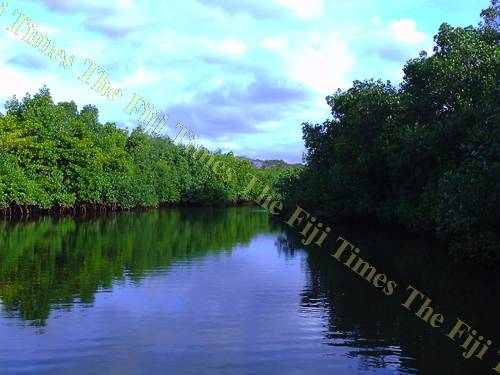
Mangroves of Fiji - Blue Carbon and other Ecosystem Services

Mangroves of Fiji noted for the many important ecosystem services they provide including:
  • Filtering land-born sediments, thereby helping to protect adjacent coral reefs;
  • Absorbing and storing the greenhouse gases (Blue Carbon);
  • Acting as nursery grounds for commercially important fish species;
  • Protecting shorelines from cyclones and tsunamis; and
  • Providing resilience to climate change
___________________________

Mangroves much maligned

Sunday, October 16, 2011, Kate Findley, WWF

Mangrove trees catch sediment from the river to build a base for their roots.

How would you describe a mangrove forest? Muddy, smelly, and mosquito-infested?

The land's not suitable to build on, the fish are small, refuse collects in the tangled web of roots that keep trying to trip you like a cartoon character, stunted shoots cut and scratch at you and it's impossible to navigate without years of experience or a compass. These are perhaps the reasons for Fiji's mangrove area declining by 13% between 1978 and 1994.

However contrary to popular belief mangrove forests are actually extremely productive and biodiverse ecosystems - linking the land to the sea they prevent debris from washing onto reefs, absorb and store the greenhouse gas carbon dioxide, and act as nursery grounds for commercially important fish including rabbitfish (nuqa), bumphead parrotfish (kalia) and many shark (qio) species.

The mangrove corridor to the Great Sea Reef

There is a close connection between mangroves and the Great Sea Reef, the third longest reef in the southern hemisphere, hugging the entire northern coast of Vanua Levu. Those in the NGO business often consider the Great Sea Reef to be "the hidden gem" of the South Pacific with its globally significant biodiversity, 12 IUCN Red Listed species including the green turtle, humphead wrasse and manta ray, as well as its sheer length.

The Great Sea Reef's health is in large part dependent on that of its mangrove corridor which fringes the Labasa River from hilltop to river mouth before the river water flows on to the reef. Mangroves roots - those extensive, tangled masses - trap particles from the river, so that the tree in effect builds an environment for itself from which it can obtain nutrients and anchor its roots.

By trapping particles, mangroves clarify and purify the water, creating that wondrously clear aquamarine water essential for coral reefs to receive sunlight and flourish; and by absorbing excess nutrients they prevent algae enshrouding the slow-growing coral.

Recent scientific evidence following the 2004 Boxing Day Aceh tsunami indicates that mangroves are also effective buffers for the shore when cyclones and tsunamis strike; fewer lives are lost and less damage is caused in communities with broader mangrove belts, earning them the nickname "bioshields".

Putting a plaster on a gaping wound

With lives and livelihoods lost in the furious flash floods that strike Labasa year after year, in 2008 it was decided to dredge the Labasa River, which flows directly through the centre of the town. Floods have always been a problem in Labasa, which is unsurprising considering it sits straddling three rivers in a flat, low-lying estuary that used to be a swamp.

For those who are not familiar with the term, dredging is the process of excavating the sediment lying at the bottom of a river bed to deposit it somewhere else, which at least in the short term deepens the water channel so it can carry a larger volume of water at any one time.

So what's the problem? Environmental group the WWF (World Wide Fund for Nature) have recently been speaking out about the impact dredging is having on the surrounding mangroves.

"Unfortunately, the act of dredging to deepen the channels and river mouth is in this case creating a false sense of security with the dredging's capacity to do more harm than good." Ms Monifa Fiu, Building Resilience Officer at WWF South Pacific commented.

"The way dredging is currently being conducted in the Labasa river just now, the material or 'spoil' that is dredged from the bottom of the river is being dumped in the first line of mangroves on the river bank, killing them."

"My fear is that as storm frequency increases due to climate change, we will have to dredge much more often, progressively destroying the layers of mangroves that line the bank."

Ms Fiu noted these dead patches on a field trip assessing the vulnerability of these mangroves to climate change as part of the major new AusAID funded 'Building Resilience' project, which aims to strengthen the resilience of the Ba and Labasa river catchments to the effects of climate change. The patches were of mature black mangroves (dogo) - a species of particular note for their protection and stabilization of low-lying coastal areas. In short, their message is clear: In Fiji we gain so much from mangroves that we cannot afford for them to be damaged as a result of poor planning. Mangrove build, mangroves protect, mangroves host and mangroves provide.

Friday, October 14, 2011

Climate Conversations - Uprooting families to save trees

A critique of REDD+, some questions to keep in mind as Blue Carbon advances:
  • Does rights and access to ecosystems present an even more intensive issue for Blue Carbon then REDD+? (Many more people live on coastlines than in forests.)
  • People have lived on coastlines for many generations, is there anything we can learn from traditional practices that promote environmental sustainability?
  • Is it possible to incorporate traditional sustainable practices into a Blue Carbon approach?
  • Is it important to ensure the right of coastal communities to the environment where they live? And how would this be accomplished in a Blue Carbon approach?
  • How could coastal communities also receive a fair share of Blue Carbon benefits?
- Steven
______________________________________________

Climate Conversations - Uprooting families to save trees

By Darryl Vhugen | Tue., October 4, 2011

In this 2005 file photo, traditional honey collectors row a boat during honey collection at Bali Island in the Sunderbans mangrove forest delta in India (REUTERS/Jayanta Shaw).

Much has been written about the global land rush –the trend in which investors, eager to establish plantations to produce food or biofuel at a discount, buy up or lease vast swaths of farmland in the developing world. In the process they often uproot entire villages, reducing small indigenous farmers to legions of landless poor.

From Uganda to Cambodia, there are reports of farmers and herders being told, often with little notice or compensation, that they must vacate their land to make room for investors.

Often, these investors have negotiated directly with central authorities and have promised jobs, technology, and infrastructure improvements in exchange for the land. But their promises of benefits to locals often go unfulfilled.

It is becoming increasingly clear that this accelerating trend of largely unregulated commercial land acquisitions threatens not only the developing world’s farmers and pastoralists, but also the world’s forests and the people who depend on them.

That’s because as farmland becomes increasingly scarce, investors and others are looking to forest land for their food and biofuel production.

At least 400 million people are highly dependent on forests for their livelihoods. These forest dwellers often have sustainably used and managed their forest land for generations.

They survive by gathering medicinal plants, and produce like honey and mushrooms. But they often have no formal legal claim to the land or forest resources. The forests they use now cover about 30 percent of the planet.

These people and the forests they use are increasingly at risk.

A recent report from the Rights and Resources Initiative highlights the implications: “Now that forest lands are increasingly valuable for agriculture, carbon and biofuels, there is greater pressure from investors and less interest by many governments to recognize the local land rights.”

Fortunately, international groups including the UN and the World Bank have created a tool called REDD+ - Reducing Emissions from Deforestation and Forest Degradation - to help protect the world’s forests.

This international program is designed to reduce greenhouse gas emissions through (1) avoiding the release of carbon stored in trees when trees are cut down; (2) encouraging the storage of additional carbon by leaving trees standing; and (3) promoting reforestation.

If the international community can agree on the details, at some point, REDD+ funds will flow to heavily forested countries that take steps to preserve and grow their forests.

It sounds good except for one missing element: the rights of forest dwellers.

Tens of millions of traditional people have lived in and around the forest for generations and managed the forest sustainably, taking what they need but ensuring that the ecosystem continues to thrive.

Will these people be allowed to continue using forest products sustainably and receive their fair share of these funds for preserving, protecting and managing the forest? Or will governments bypass the people and pocket all of the money themselves?

Recent headlines make clear, no matter what the source of the demand for forest land (conservation or timber), traditional forest dwellers can be the big losers as more powerful interests, public and private, force them out of the forest or preclude them from engaging in their customary activities.

Admirable motives could lead to deeply troubling unintended consequences – families uprooted to save trees.

This is discouraging particularly because research indicates that forests that are actively managed by local communities thrive. They can actually have lower rates of deforestation than protected areas where forest resource use is completely prohibited.

And obviously from a social stability, socio-economic and human rights standpoint, allowing these traditional people to remain in the forest makes sense.

For the past several months a team at Landesa has conducted a U.S. Agency for International Development (USAID)-funded study of the property rights implications of REDD+.

We carried out field research in Indonesia, Mexico, Nepal, Tanzania and Mozambique. One of our conclusions is that for REDD+ to be effective in the long-term, and for the world to create a sustainable forest conservation program, a substantial portion of the financial benefit must go to the communities who have the ability to manage and protect the forest.

Often that will be the local, forest-dependent community.

Such a path would require governments, many of whom are poor and cash strapped, to forego a part of the REDD+ payments they would receive and pass the cash on to often powerless and voiceless forest dwellers. Recent reports indicate that this is not happening.

In order for REDD+ to be successful, these forest communities must have secure rights to the land where they live. They must also receive a fair share of REDD+ benefits.

Otherwise, the remaining tropical forests will continue to shrink and we will undermine one of the most cost-effective and promising climate change strategies available.

Darryl Vhugen is a senior attorney and land tenure specialist with Landesa, a non-profit organisation that has advised and partnered with government departments and other groups in more than 40 countries to help extend secure land rights to the rural poor.